


Amandinea punctata
≡Verrucaria punctata Hoffm., Deutschl. Fl.: 192 (1796).
≡Buellia punctata (Hoffm.) A.Massal., Ric. Lich. Crost.: 81 (1852).
Description : Flora (1985: 51 – as Buellia punctata). See also Scheidegger (1993).
N: Northland (Whangarei, Great Barrier I.) to Wellington (Lower Hutt, Titahi Bay). S: Marlborough (NE of Kaikoura), Canterbury (Christchurch, Okains Bay) to Southland (Invercargill). On trees and shrubs – common on Metrosideros excelsa in polluted sites (especially alongside motorways) in the north; elsewhere on introduced trees (Fraxinus, Platanus etc.) in towns and cities where it can withstand moderate to high levels of atmospheric pollution; also on coastal rocks. Known also from Great Britain, Europe, Scandinavia, North America, Brazil, Australia, South Georgia, South Sandwich Is, South Orkney Is, Antarctic Peninsula and continental Antarctica (Øvstedal & Lewis Smith 2001; Aptroot 2002e; Mayrhofer & Moberg 2002a; McCarthy 2003c; Nimis & Martellos 2003; Santesson et al. 2004).
Cosmopolitan
Illustrations : Johnson et al. (1995: 334 – as Buellia punctata); Dobson (2000: 55; 2005: 61); Wirth (1995: 120); Brodo et al. (2001: 159, pl. 107); Nordic Lichen Flora Vol. 2 (2002: 89); Blaha (2002: 43, fig. 17; 44, figs 18, 19).
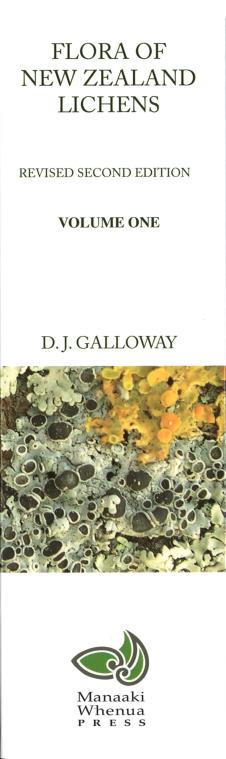
Amandinea punctata is characterised by: the corticolous habit (it also occurs on coastal rocks); the warty, olive-grey to silver-grey thallus; small, frequent, scattered, plane to convex, matt, black apothecia (often in concentric circles when well-developed); and olive-brown to dark-brown, ascospores (12–)17–20.5(–22) × 7–8.5(–10) μm, with a finely warted wall.
